For PornLess, this news highlights two distinct needs: protecting minors and enabling adults to make their own choices. Age confirmation establishes whether someone is an adult. It does not tell us whether their pornography use aligns with their personal wishes. Anyone who frequently stays online longer than intended, or wants to make a change, can reflect on their habits and seek support. There is no need for shame or moral judgement.
PornLess is for adults who want to reflect on, reduce or intentionally take a break from pornography use. You can find more information and the free self-check at PornLess.app.
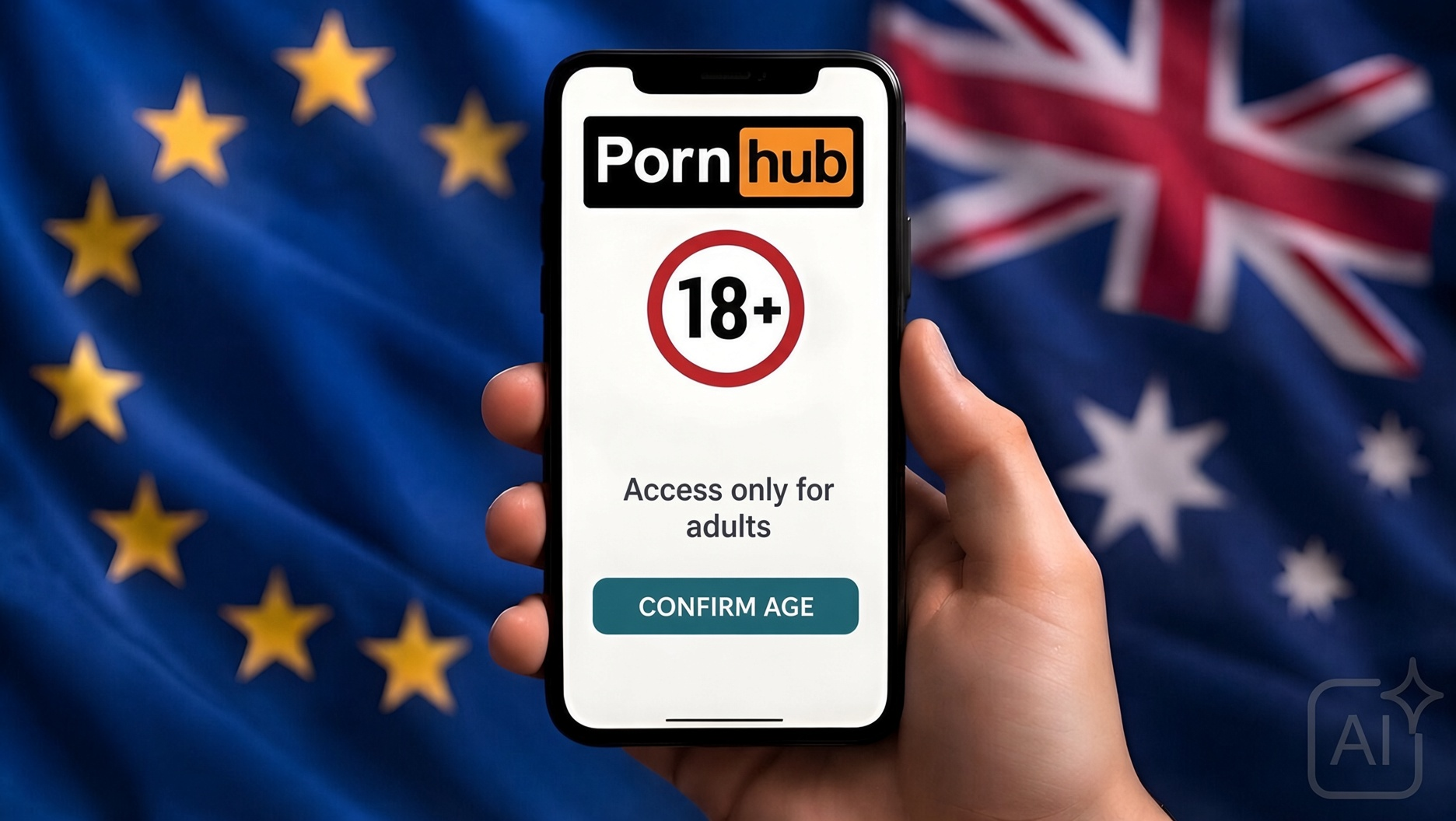
Pornhub is reopening access in Australia for some adult users. In a statement dated 6 October 2026, operator Aylo announced that eligible Australian iOS users whose ages have been confirmed by Apple would be allowed back. They must have been confirmed as adults through Apple's Australian process. The announcement therefore concerns a specific group of users and does not mean unrestricted access across all devices. [1]
The background is Australia's stricter requirements for age-restricted online content. Six further relevant industry codes came into force on 9 March 2026. Pornography services must use appropriate age checks. [2] Aylo subsequently restricted access to its platforms; according to Reuters at the time, Pornhub displayed only a version without explicit content in Australia. Potential fines of up to A$49.5 million were cited in connection with the new rules. [3]
Apple's process confirms adult status through an Apple Account. Existing account information may be taken into consideration, such as a credit card on file or how long the account has existed. Depending on the options available, users may also confirm their age with their own credit card or by scanning a passport, driving licence or other government-issued ID. Debit cards and gift cards are not supported for this purpose. [4]
For Australian Apple Accounts, safeguards such as web content filtering and Communication Safety are enabled automatically for children, teenagers and adults who have not yet been confirmed as adults. People who do not confirm their age can generally continue using their devices. However, certain changes to safeguards and downloads of apps rated 18+ require confirmation. [5]
Aylo presents this approach as a particularly effective and privacy-friendly solution. In the company's view, device-level age checks can be designed so that adults do not have to submit personal proof repeatedly to numerous individual websites. This assessment comes from the operator itself. It is not independent evidence that its specific implementation reliably prevents minors from gaining access. [1]
A comparable approach is under scrutiny in the United Kingdom. On 23 September 2026, media regulator Ofcom announced an investigation into Aylo. Since May, Pornhub has used signals for some users in the UK indicating that they have completed Apple's age verification. Ofcom has concerns about whether Aylo sufficiently assessed and tested, before introducing the process, how reliably it prevents children from accessing the service. [6]
The scope of the investigation is clearly defined: Ofcom is examining how Aylo integrated these signals into its own age checks. In these proceedings, the regulator is not deciding how Apple itself operates its age verification. An investigation is also not a finding of a breach. The published investigation remained open at the time of this article. The UK scrutiny therefore establishes neither the effectiveness nor the failure of the Australian solution. [6]
Privacy also depends on the specific implementation. Australia's eSafety regulator requires age checks to collect as little personal information as possible and to comply with applicable privacy rules. Government-issued ID should not be the only form of proof offered. These industry codes do not require data about individual users to be sent to eSafety. [7] When assessing a process, it therefore remains essential to establish what data are actually processed and who can access them.
There is a direct connection to Europe: the European Commission is also providing a technical foundation for digital proof of age. The blueprint, technically available since April 2026, is intended to let people prove to a website that they are adults without disclosing their name or exact date of birth. The website should receive only confirmation that a person meets the required age threshold. Member States and other providers can use it to develop their own apps or integrate the function into digital identity solutions. [8, 9]
On 29 April 2026, the Commission called on Member States to make such services available by the end of 2026. The actual launch depends on each implementation. [10] The comparison illustrates a shared task approached through different technical and legal frameworks: in Australia, Pornhub's current reopening relies on Apple's age confirmation for eligible users. The European blueprint aims to establish a common standard for different providers. How reliably such proof works in everyday use must be assessed in each specific application.
Sources and further reading
[1] Aylo: Announcement on the return of Australian iOS users. 6 October 2026.
[2] eSafety Commissioner: Online Safety Codes and Standards. As of 17 September 2026.
[4] Apple Support: If you’re asked to confirm that you’re an adult. 14 September 2026.
[5] Apple Support: Age requirements for managing an Apple Account in Australia. 14 September 2026.
[6] Ofcom: Investigation into age assurance at Aylo and Pornhub. Published 23 September 2026.
[8] European Commission: The EU approach to age verification. Accessed 9 October 2026.
[9] European Commission: EU Age Verification Solution. FAQ, as of 18 May 2026.
[10] European Commission: Commission urges fast rollout of age verification app. 29 April 2026.